PERFLUOROPROPANE

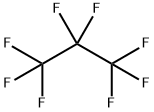
PERFLUOROPROPANE structure
  • CAS No.:76-19-7
Other grades of this product :
PERFLUOROPROPANE Basic information
Product Name:PERFLUOROPROPANE
Synonyms:genetron218;hfc218;octafluoro-propan;optison;propane,octafluoro-;R 218;r218;Perfluoropropaneminimum
CAS:76-19-7
MF:C3F8
MW:188.02
EINECS:200-941-9
Product Categories:refrigerants;Organics
Mol File:76-19-7.mol
PERFLUOROPROPANE Chemical Properties
Melting point -183 °C
Boiling point -39 °C
density 1.35
refractive index 1.2210 (estimate)
storage temp. Refrigerator
CAS DataBase Reference76-19-7(CAS DataBase Reference)
EPA Substance Registry SystemPerfluoropropane (76-19-7)
Safety Information
Hazard Codes F
Safety Statements 9-23-38
RIDADR 2424
HazardClass 2.2
HS Code 2903493090
Hazardous Substances Data76-19-7(Hazardous Substances Data)
ToxicityLD50 intravenous in dog: > 20mL/kg
MSDS Information
PERFLUOROPROPANE Usage And Synthesis
UsesUltrasound contrast imaging in cardiology and radiology (diagnostic).
UsesPerfluoropropane is a non flammable greenhouse gas that is used in management of retinal tears in eye. It is also used in refrigeration mixtures.
Brand nameDefinity (Bristol-Myers Squibb).
General DescriptionPERFLUOROPROPANE is a colorless, odorless gas. PERFLUOROPROPANE is relatively inert. The mixture is nonflammable and nontoxic, though asphyxiation may occur because of displacement of oxygen. Exposure of the container to prolonged heat or fire can cause PERFLUOROPROPANE to rupture violently and rocket.
Reactivity ProfilePERFLUOROPROPANE is chemically inert in many situations, but can react violently with strong reducing agents such as the very active metals and the active metals. They suffer oxidation with strong oxidizing agents and under extremes of temperature.
Health HazardVapors may cause dizziness or asphyxiation without warning. Vapors from liquefied gas are initially heavier than air and spread along ground. Contact with gas or liquefied gas may cause burns, severe injury and/or frostbite. Fire may produce irritating, corrosive and/or toxic gases.
Fire HazardSome may burn but none ignite readily. Containers may explode when heated. Ruptured cylinders may rocket.
Purification MethodsPurify it for pyrolysis studies by passage through a copper vessel containing CoF3 at about 270o, then fractionally distil it. [Steunenberg & Cady J Am Chem Soc 74 4165 1952.] Also purify it by several trap-to-trap distillations at low temperatures [Simons & Block J Am Chem Soc 59 1407 1937].

Important Notice

  1. This product is a chemical product/pharmaceutical intermediate. It is not a drug, an active pharmaceutical ingredient (API), or a pharmaceutical-grade material. It has not been granted a drug approval number or a Chemical Drug Substance Approval Notice, has not passed drug-related review and approval, and is not manufactured, tested, or released in accordance with pharmaceutical GMP.
  2. This product is intended solely for non-clinical research, process development, quality studies, further chemical processing, or chemical synthesis. It must not be used in drug-product manufacturing, clinical trials, clinical diagnosis, or administration to humans or animals, or be sold, used as an input, submitted for regulatory filing, or released as an API or pharmaceutical material.
  3. The purchaser must not use this product, or supply it to another party, for personal consumption, sports or fitness, weight loss, health supplements, food, or animal feed.

Welcome!

Please leave a message for us or use the following ways to contact us, we will reply to you as soon as possible, and provide you with the most sincere service, thank you.

  • NO. 18 ,Wujiang Road, Wulidian Street, Jiangbei District, Chongqing
  • +86-23-6139-8061 +86-13650506873
  • danny@chemdad.com sales@chemdad.com
  • www.chemdad.com
  • WhatsApp +86-13650506873

Name

phone

company

email

message

Read the full Disclaimer
Payment methods
Google translate: 日本语日本语 한국어한국어 FrançaisFrançais DeutschDeutsch EspañaEspaña TürkiyeTürkiye